Working Groups
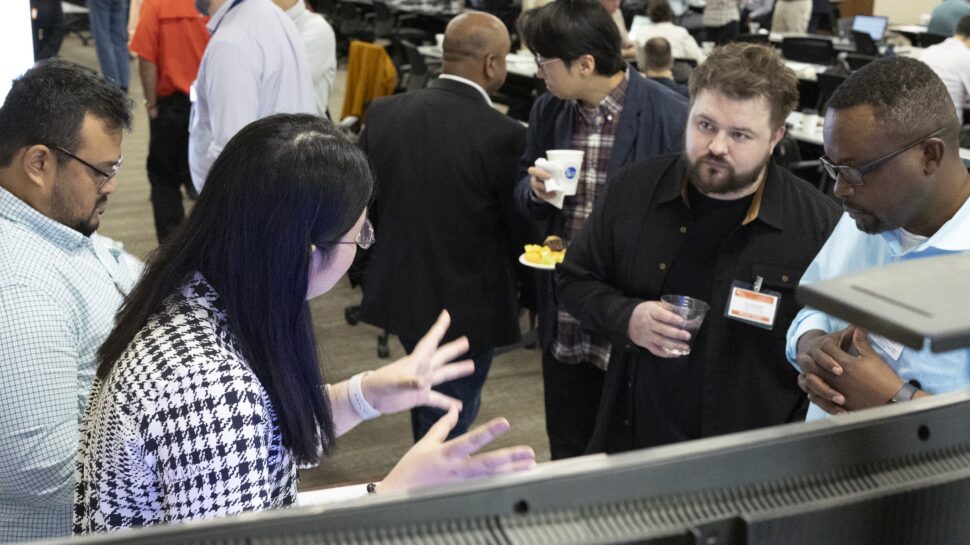
The collaborative efforts of GEMS working groups advance electromagnetic transient simulation tools, models, features, and training, supporting a reliable and secure electric grid for the future.
Applications and Pilots
The Applications and Pilots Working Group creates standardized EMT simulation approaches for integration, planning, protection, operational support, and model validation. They set testing requirements for stakeholders, address reliability, harmonics, fault analysis, and power quality, and validate models against measurements. The group reviews current practices, runs disturbance scenarios, analyzes mitigation options, and develops frameworks for model quality and stakeholder needs, aiming to reduce integration failures and improve overall grid reliability.
Input Data Structure and Models
The Input Data Structure and Models Working Group develops EMT models at various detail levels for grid components, including large loads like data centers. Their efforts support integration studies by replicating real-world events and interactions with inverter-based generation. They incorporate vendor-supplied black-box models into simulations while protecting intellectual property. The group proposes a new input data structure for interoperability, introduces benchmark models for modern grids, and enables testing of solvers, disturbance studies, and post-processing algorithms.
Solvers
The Solvers Working Group advances solver technologies and architectures for EMT simulation to address the slowness and limited scalability of these simulations, with an emphasis on near real-time studies of large-scale power grids comprising tens of millions of nodes and millions of inverters. This working group researches integrators, parallel solvers and workflows, AI augmentation, and benchmarking frameworks to support robust, large-scale EMT simulation.
Features
The Features Working Group enhances EMT simulation workflows by developing tools and methods that streamline pre- and post-processing, automate routine tasks, and improve efficiency. Their focus includes AI-assisted modules for model creation, grid screening, scenario selection, stability assessment, root-cause analysis, visualization, and reporting. The group aims to identify core features needed for modern EMT studies and demonstrate them on real-world cases, reducing manual engineering effort and supporting large-scale, consistent simulations.
Training and Workforce Development
The Training and Workforce Development Working Group reviews the current state of EMT simulation education and training and recommends modular, cross-disciplinary content to address gaps. The initiative maps resources like textbooks, syllabi, and lectures into progressive modules for various audiences, supporting curriculum design and an EMT certificate program. It promotes open-source tools and materials via a centralized online repository.
